

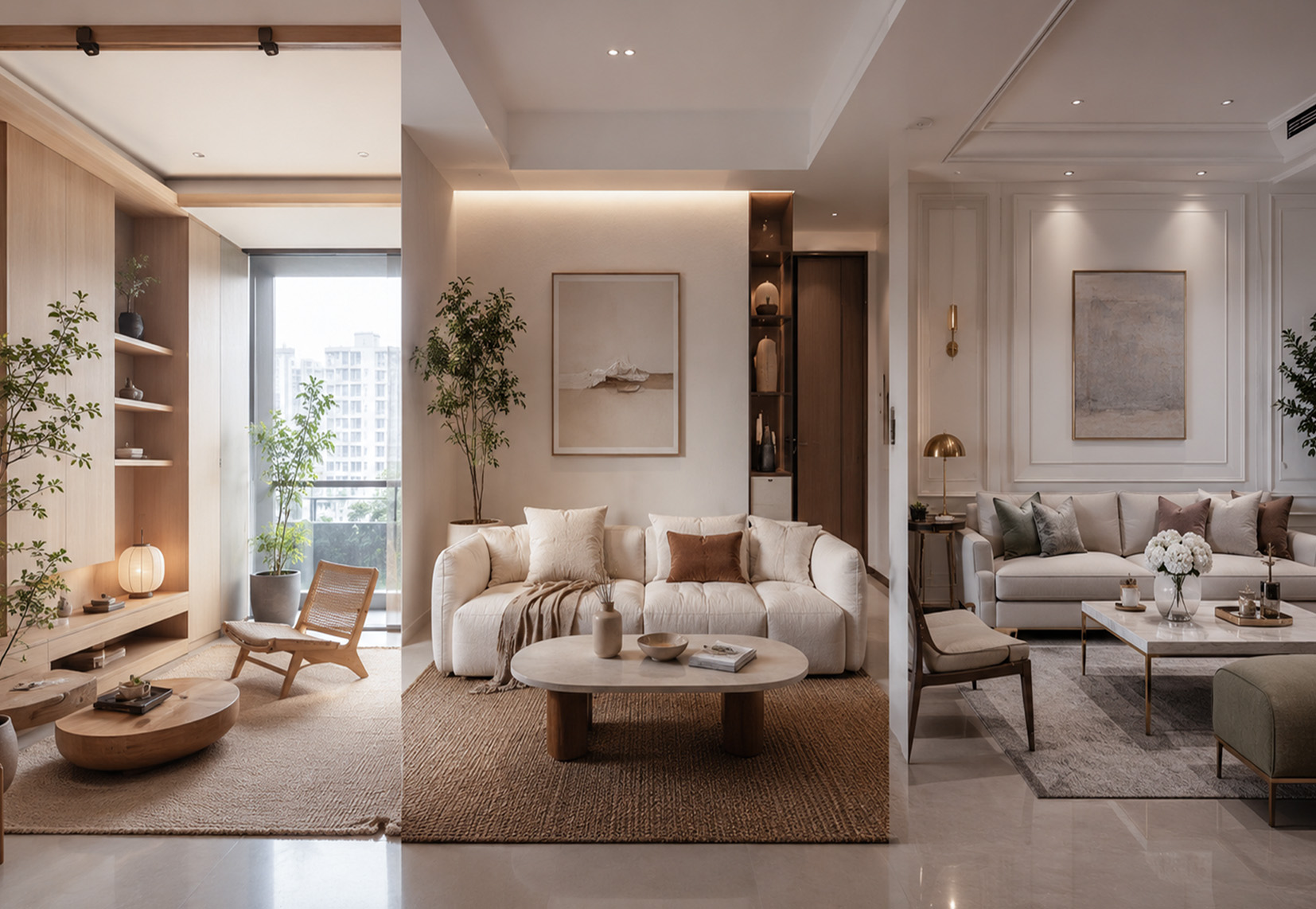
Japandi, Warm Minimalism or Modern Classic: Which Style Fits Your Home?
Key Takeaways
- Selecting from the most popular interior design styles, Singapore homeowners’ choice comes down to how they really live, not which style appears best in pictures.
- Japandi Interior Design is for people looking for tranquillity, simplicity, and an association with nature in a small space.
- Warm minimalism is perfect for people who want sleekness but also feel minimalism is too sterile for their tastes.
- Modern classic interior design is right for those who value durability, symmetry, and timeless style.
- With over 20 years of experience, MJS Interior will ensure that your chosen style translates into an effective renovation for long after the completion date.
Introduction
You’ve seen those photos. The bright living room is complete with the well-placed bookshelf and the plant. A kitchen that has yet to be used. The bedroom is straight out of a hotel.
Most homeowners in Singapore begin any renovation project by creating a mood board. They collect images, determine a general visual theme and come to see a designer with an identifier like “I want to have something Japandi” or “I would like something in the style of a modern classic.” The identifier is helpful, but generally not specific enough to develop into a brief.
According to the Space Survey of more than 1,000 Singapore respondents conducted by StorHub, 60% of Singaporeans stated that they would be more productive at home with more space. Also, 62% of those surveyed stated that they had decluttered their homes in order to create extra space to work and study.
The survey results also showed that 70% of people kept their home offices as they became accustomed to hybrid working. On top of it, the average size of an HDB flat has reduced from 1,400 sq ft in the 1990s to 970 sq ft in the mid-2010s.
In 2026, the three interior design trends that Singapore homeowners keep asking for are Japandi, Warm Minimalism, and Modern Classic. Here in this blog, we are going to understand what each trend entails, under what conditions it works well in Singapore, and what kind of family would benefit from it.
What Are The Interior Design Styles Singapore Homeowners Choose Today?
Interior design styles in Singapore can be defined as visual and spatial constructs used by homeowners to make informed decisions regarding renovations, such as material choices, colour schemes, furniture sizing, and joinery design.
Design trends of 2026 that will dominate in Singapore will belong to the range of calm and neutral. Indeed, Japandi, Warm Minimalism, and Modern Classic share a philosophy of neatness and a thoughtful way of living, but their differences lie in mood, attitude to decorations, and ability to withstand an active family life.
Japandi Interior Design: Restraint with Intention
Japandi interior design is the result of a combination of design ideas from both Japan and Scandinavia. As per the Japandi design guide by Hovia, the concept was created in the year 2016; however, the interaction between the Scandinavian and Japanese designers has existed for the past 150 years, and can be seen through crafts like pottery and architectural style and Danish furniture.
In 2026, according to the State of Home Design by Apartment Therapy survey conducted among 140 designers, Japandi is one of the most popular design aesthetics of the year.
What separates Japandi from minimalism is the feeling of warmth. As described by Hovia, Japanese wabi-sabi focuses on perfection while accepting that the natural beauty of materials is beautiful in itself, while Scandinavian hygge adds comfort and functionality. It is in this manner that you get a cosy atmosphere rather than a minimalist one.
Core elements of Japandi interior design include:
- Stone tones, warm greys, muted sage, and earthy ochre palettes.
- Natural or dark-stained timber finishes.
- Low-profile furniture inspired by Japanese interiors.
- Floor-level visual balance that creates openness.
- Minimal ornamentation and restrained styling.
- Negative space is treated as part of the design language.
- Honest, tactile materials with visible texture.
- Calm visual continuity across rooms.
- Soft warmth rather than stark minimalism.
- Functional layouts with reduced visual clutter.
Why does Japandi work well in Singapore homes? It works because it:
- Uses restraint to create perceived spaciousness in compact HDBs and condos.
- Makes smaller floor plans feel visually lighter and more open.
- Works effectively with floor-to-ceiling built-ins and concealed storage.
- Creates calm, low-noise environments suited to dense urban living.
- Supports intentional living through simplified layouts and fewer objects.
A 4-room flat executed in Japandi with consistent material tones, floor-to-ceiling built-ins, and a low-furniture arrangement can feel significantly larger than its floor plan suggests.
The maintenance challenges of Japandi often include:
- Every item needs to earn its place visually.
- High dependence on integrated storage infrastructure.
- Difficulty maintaining visual discipline over time.
- Limited tolerance for visible clutter or excessive accessories.
- Aesthetic constraints for households with young children or high storage needs.
- Less flexibility for homeowners who prefer expressive decoration.
For a deeper look at the Japanese design principles that underpin this approach, the 4 principles of Japanese-inspired design on the MJS Interior blog cover the philosophy in practical terms.
A well-executed Japandi home doesn’t feel empty. It feels deliberately quiet, and that quiet is the point.
Warm Minimalism: Clean Lines with Permission to Breathe
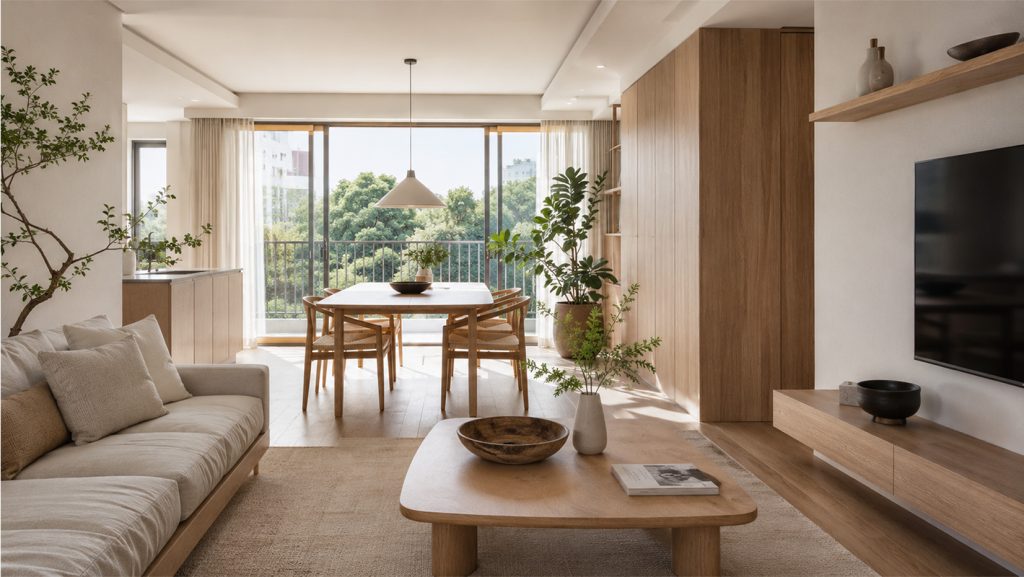
Warm Minimalism can be said to exist in the middle path of Japandi philosophy and the minimalist style of design. It maintains the characteristics of minimal designs like straight lines, uncluttered surfaces, and a neutral colour palette while incorporating soft elements such as textures, lighting, and larger furniture.
Warm minimalism is about:
- Clean lines without visual harshness.
- Neutral palettes softened through texture and lighting.
- Rounded furniture edges instead of sharp profiles.
- Warm ambient lighting is layered throughout the space.
- Comfortable seating with fuller, softer proportions.
- Edited interiors that feel calm rather than empty.
- A balance between restraint and livability.
- Visual simplicity without rigid minimalism.
Unlike Japandi, Warm Minimalism is more flexible in its material language. Instead of relying on a tightly controlled palette, it allows a broader combination of finishes and textures to coexist comfortably.
Common material and styling elements include:
- Oak and walnut finishes are used interchangeably.
- Fluted plaster walls paired with polished concrete flooring.
- Natural fabrics and tactile upholstery.
- Rounded silhouettes that soften the visual structure of the room.
- Multiple lighting layers replacing a single ceiling fixture.
- Textural variation that creates warmth without clutter.
The result is a home that feels edited rather than rigid. Warm minimalism suits Singapore homeowners who:
- Appreciate minimalist interiors but find pure minimalism too clinical.
- Want calm spaces that still feel comfortable to sit in daily.
- Cook often and use the kitchen as an active social space.
- Entertain guests regularly.
- Prefer homes that feel relaxed instead of formally styled.
- Want flexibility without losing visual cohesion.
The style also tolerates accessories more comfortably than Japandi. Decorative elements that may feel disruptive in stricter minimalist interiors can integrate naturally within a warm minimalist home.
Accessories that work well within this style include:
- A well-chosen artwork.
- Small ceramic groupings.
- Textured throws and soft furnishings.
- Layered textiles with subtle tonal variation.
- Carefully selected decorative accents that maintain visual calm.
This makes warm minimalism both a more forgiving renovation brief and a more forgiving home to live in over time. The main challenge with Warm Minimalism lies in material selection. The warmth must come from palette and texture choices rather than from excessive decoration.
Elements that support the warm minimalist look:
- Pale limewash walls.
- Natural linen curtains falling to the floor.
- Bouclé sofas and textured upholstery.
- Warm layered lighting.
- Soft natural finishes with visible tactility.
Elements that weaken the effect:
- Flat beige paint without texture.
- Synthetic upholstery materials.
- Standard ceiling lighting without layering.
- Decorative clutter used to imitate warmth.
Getting those substitutions right is what separates a genuine Warm Minimalism home from a simply beige interior.
Modern Classic Interior Design: Symmetry and Staying Power
Among the three types of designs, classic modern design is the least trend-bound. Classic modern interior design borrows heavily from principles of classical interior design like symmetry, proportions, use of high-quality materials, among others. However, the application is done using a modern approach.
Key characteristics of modern classic interior design include:
- Panelled feature walls.
- Crown moulding or shadow line detailing.
- Marble or marble-look surfaces.
- Symmetrical furniture arrangements.
- White, ivory, charcoal, and brass-accented palettes.
- Structured upholstered seating with visual weight.
- Joinery with subtle ornamentation.
- Balanced proportions and formal composition.
Compared to Japandi or Warm Minimalism, modern classic interiors typically feel richer and more grounded visually. The style suits homeowners who:
- Want a renovation that ages well over time.
- Prefer interiors that feel timeless rather than fashionable.
- Entertain guests frequently.
- Like a balance between formal and relaxed living spaces.
- Live in larger flats, condos, or landed properties with more spatial volume.
A well-executed modern classic home can still feel appropriate and relevant a decade later. The main challenge with modern classic interiors is visual heaviness, especially in Singapore’s more compact homes.
Common execution risks include:
- Joinery-heavy feature walls overwhelm smaller spaces.
- Structured furniture makes rooms feel crowded.
- Excessive detailing reduces visual openness.
- Too many classical elements competing within the same room.
The style performs best when executed with restraint. Using two or three classic details well is often more effective than applying every available decorative element at once.
A practical approach includes:
- Using the living or dining room as the main style anchor.
- Allowing bedrooms and secondary spaces to adopt a quieter version of the same aesthetic.
- Balancing architectural detailing with cleaner contemporary surfaces.
- Maintaining sufficient floor space around heavier furniture pieces.
For homeowners trying to place modern classic within the broader spectrum of Singapore styles, the contemporary vs. modern interior design comparison on the MJS Interior blog provides useful grounding on how these terms relate to each other in practice.
A modern classic home doesn’t date because it never fully commits to a single moment. It borrows from the past and edits out everything that won’t last.
How Do the Three Styles Compare in a Singapore Context?
| Style | Best Suited For | Strengths in SG Homes | Characteristics | Potential Challenges |
|---|---|---|---|---|
| Japandi | Smaller flats with one or two occupants | Creates perceived spaciousness in compact HDBs and condos | Intentional living, restrained styling, fewer but higher-quality objects, disciplined layouts | Requires consistent upkeep, strong storage infrastructure, and low tolerance for visible clutter |
| Warm Minimalism | Families and multi-generational households | Most adaptable across flat sizes and property types | Comfortable, flexible, accessory-friendly, tolerant of everyday life and layered textures | Depends heavily on correct material and texture selection to avoid looking generic or flat |
| Modern Classic | Larger homes, older homeowners, and households that entertain frequently | Performs best in condos and landed homes with higher ceilings and generous room dimensions | Formal presence, symmetry, architectural detailing, timeless visual structure | Can feel visually heavy in compact homes if proportions and detailing are not carefully controlled |
All three styles favour:
- Built-in storage over freestanding furniture.
- Warm layered lighting over single overhead fixtures.
- Material continuity across the main living areas.
- Calm and visually cohesive spatial planning.
Those foundational decisions matter more during the brief stage than simply choosing a style label and expecting the details to resolve themselves later. Those principles apply regardless of which direction a homeowner chooses, as the Scandinavian design guide for Singapore homes also illustrates through a related aesthetic lens.
Which Interior Design Style in Singapore Fits Your Home?
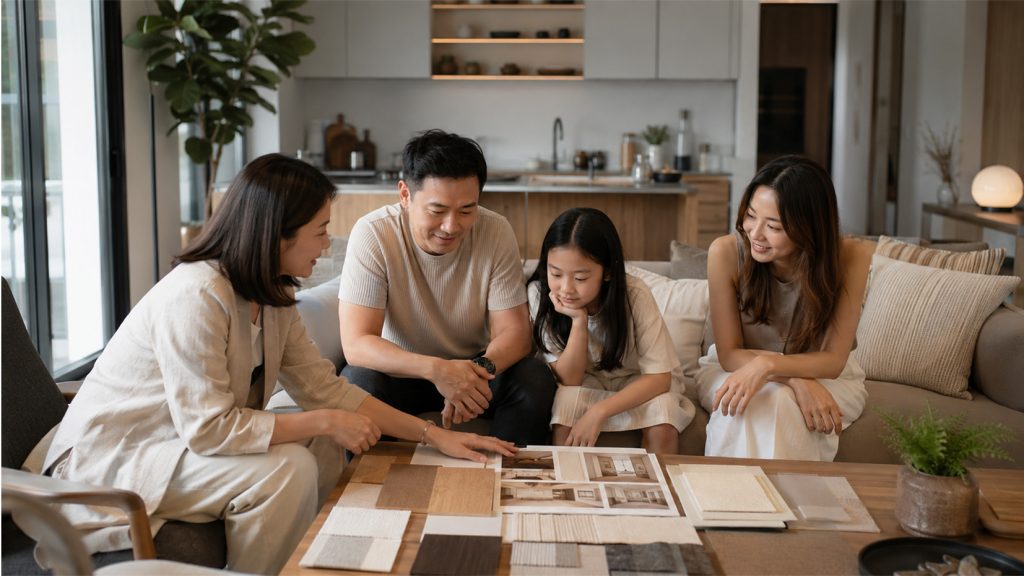
For interior design styles, Singapore homeowners should adopt one that reflects both the homeowner’s taste as well as his or her living situation. Japandi reflects the lifestyle of people who have very little in their lives and who find peace within it. Warm minimalism reflects the need for clean and peaceful rooms that can still feel like home.
The same applies to Modern Classic, where longevity, formality, and the ability to preserve home character over time are some of the aspects that reflect it. Each of the three styles reflects this concept differently, and the right style is that which would still make you satisfied in five years.
If you are not sure of what style direction to take, the most pragmatic way of determining this would be to reflect on what your home is like three months down from your last renovation. If it felt good to move into it at the initial stage, yet it soon became cluttered, then Japandi may not be the style you should go for.
FAQs
Q1. What are the most popular interior design styles among Singapore residents in 2026?
There are three leading residential styles in the Singaporean housing market at present: Japandi, warm minimalism, and modern classic. They all belong to the serene and neutral palette, yet differ in their material palette, decoration tolerance, and type of family they accommodate.
Q2. Can Japandi interior design be used by families with small kids?
Japandi interior design style is suitable for families; however, it needs a proper organisation system that keeps things off the surface. It is important to have built-in joinery to store toys, study supplies, and other household stuff. Otherwise, the visual simplicity of this style will get destroyed in no time.
Q3. How are Japandi and Warm Minimalism different?
Japandi is based on the particular culture and mixes the aesthetics of the wabi-sabi philosophy of Japan with the practicality of Scandinavian design. Japandi uses particular materials and likes low-profile furniture and dark natural wood. Warm Minimalism has no restrictions and offers the same aesthetics, adding textures and round shapes to it and accessories as long as it does not break the logic of the style.
Q4. Can modern classic design be used for the interior of a 4-room HDB flat?
It can, but it needs some proportional editing. Modern Classic components that scale well in small rooms are panelled walls with minimal detailing, marble-look surfaces on countertops and bathroom sinks, symmetrical placement of furniture, and warm gold or brass handles and other hardware details. This design is better to use only some of its elements at a time.
Q5. How should I decide which of these three interior design styles for Singapore I will use for my home?
Always begin from where you live instead of what you would like your home to be. Japandi is suited for people who have strict discipline in their living space and prefer the use of natural materials. Warm Minimalism is for people who want order and peace but do not have the material rigor.
Conclusion
Deciding which of the three popular interior design styles that Singapore homeowners choose in 2026 will not be determined by which one looks best on its own. What matters most is the style’s sustainability after the renovation is finished and life becomes more predictable for the family again.
There will be differences in how Japandi, Warm Minimalism, and Modern Classic work in practice, depending on each house, the amount of space, and its use of it.
For over two decades, MJS Interior Design has been a part of the Singapore interior design and renovation industry with many projects under our belt. As a CaseTrust-RCMA-accredited interior design company, the designers and architects can work with all types of properties in Singapore, from HDB flats to condominiums and landed houses.
We create sustainable and well-balanced living environments that last even after the handover. For any assistance with interpreting a particular design direction into a renovation brief that makes sense across joinery, lighting, materials, etc., we invite you to check out the entire suite of design and renovation services provided by MJS Interior.
From tranquil Japandi-style abodes to the ever-lasting Modern Classic interiors, MJS Interior creates spaces based on the lifestyle of contemporary Singapore homeowners. We also provide consultation, 3D design preview, and renovation coordination services.