

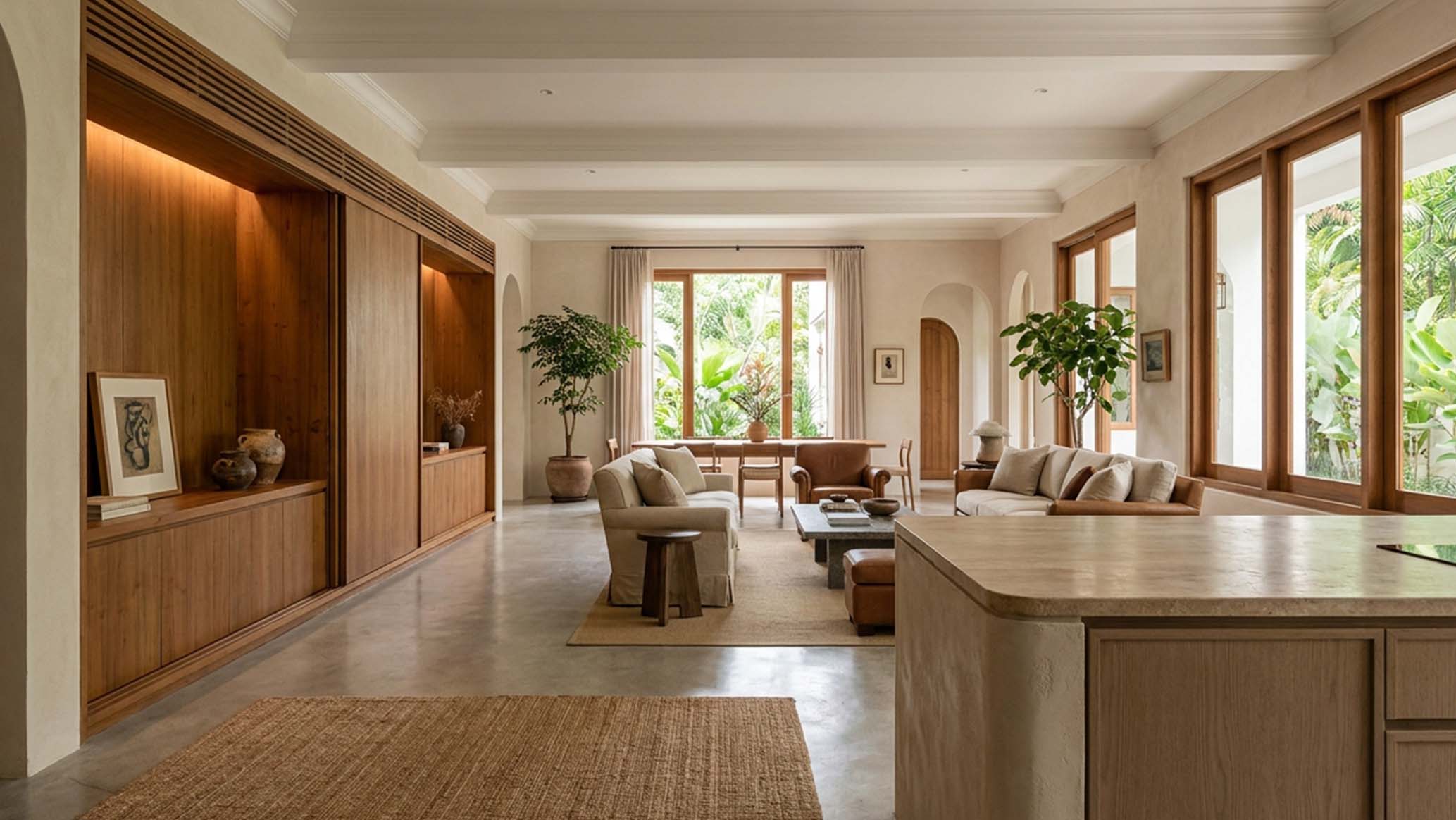
Why Some Renovations Age Better Than Others
Key Takeaways
- Timeless home design in Singapore tends to come less from choosing the right style and more from how much consideration went into the decisions that are hard to change later.
- Renovations that date quickly often do so because trend-driven choices were applied to permanent elements: the joinery, the ceiling, the flooring. These are disruptive and costly to redo.
- Decisions that are easier to update, like paint, soft furnishings, and accessories, are where personality can come through without locking it in.
- Spatial quality tends to outlast surface styling. A well-proportioned room with good light and functional storage can absorb changes in colour and texture over the years.
- Renovation ideas in Singapore that hold up well over time tend to focus on how a space functions and flows, not just how it looks at a single point in time.
Introduction
The question most homeowners ask before renovation is: “What do I want this space to look like?” A more durable question is: “How much would it cost to change this five years from now?”
The two questions lead to different decisions. The first focuses on the final image. The second forces a distinction between what is easy to update and what is locked in once the renovation is done. Homes that handle that distinction well tend to age better than homes that do not, regardless of the style that was chosen.
The question worth asking before any renovation commitment is not “does this look good right now?” but “how much would it disrupt daily life to change this in five years?”
Why Do Some Renovations Age Faster Than Others?
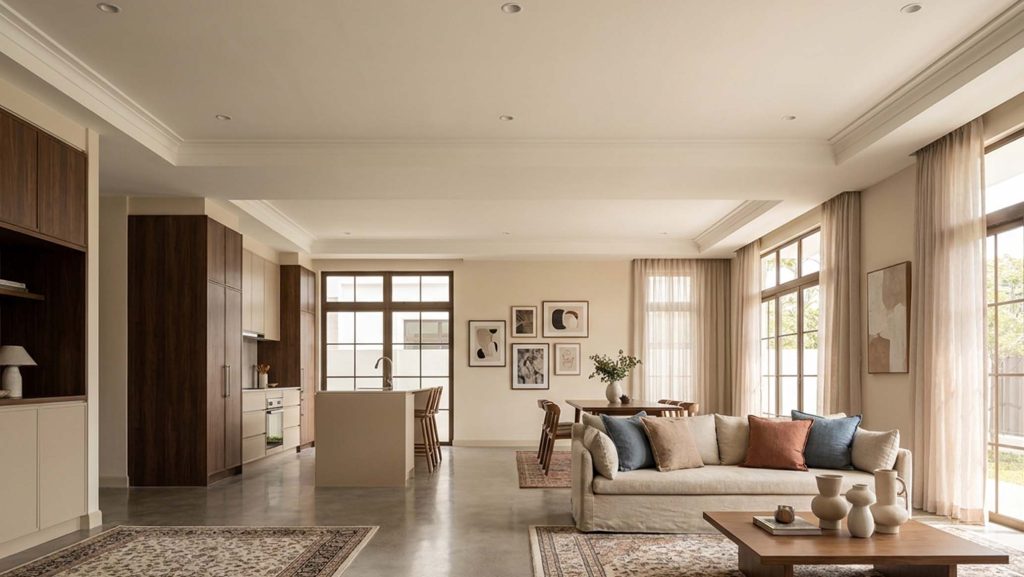
Joinery, flooring, ceiling features, and built-in cabinetry are difficult and expensive to change after the renovation is complete. When these elements are the primary vehicles for a trend-driven aesthetic, the home’s appearance becomes tied to the period when those choices were made. A few years on, the joinery or ceiling treatment that felt fresh can become the most prominent reminder that the renovation happened at a particular moment in time.
Surface finishes and movable pieces work differently. Paint can be redone in a weekend. Curtains, cushions, and rugs can be changed without a contractor. Artwork and accessories add character without commitment. When the more expressive choices live in these layers, the home can shift alongside the people in it.
What Are the Decisions That Tend to Age Well?
Not all permanent decisions carry the same aesthetic risk. Here is how common renovation decisions compare:
| Decision | Aesthetic risk | Why |
| Layout and spatial flow | Low | Spatial quality is perceptual and does not tie a space to a specific era |
| Flooring material and tone | Low to medium | Neutral, natural materials sit comfortably against a range of future changes |
| Built-in joinery proportion and placement | Low | Well-proportioned built-ins read as resolved; distinctive shapes or finishes date faster |
| Ceiling height and treatment | Medium | Minimal ceilings tend to hold up; elaborate sculpted treatments can date |
| Laminate and surface pattern choices | Higher | Pattern-heavy or highly distinctive finishes can tie a space to a specific period |
Decisions grounded in spatial logic, proportion, and natural materials tend to carry lower aesthetic risk. A layout that makes a room easier to live in does not date. Good natural light does not date. Storage that actually matches how the household operates does not date.
What tends to date faster is the surface layer sitting on top of these foundations: the ornamental ceiling coffers, the heavily patterned laminate, the feature wall treatment that was very much of its moment.
What Tends to Date a Renovation in Singapore?
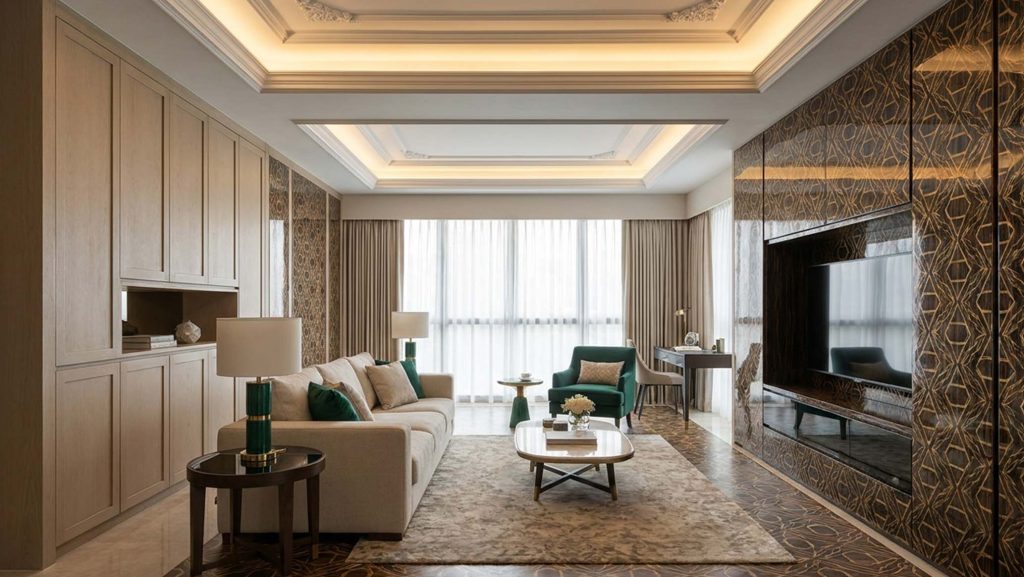
These four patterns tend to show up in renovation ideas in Singapore that start to feel tired earlier than expected:
- Joinery where the finish is the point. Unusual shapes or eye-catching surface treatments on built-in cabinetry can feel fresh for a few years and then become the defining feature of a room, whether or not that is still wanted. When the finish carries all the character, the room has limited room to shift.
- Ceiling treatments designed to impress. Multi-tier ceilings, ornamental coffers, and elaborate lighting channels became common in Singapore renovations during a particular period. They are structurally committed and strongly associated with a specific window of time.
- Every element references the same theme. When flooring, joinery, walls, and accessories all pull from the same narrow aesthetic direction, there is no visual breathing room. Updating any one element can make the others look mismatched.
- Laminate choices that follow the moment. Laminates with distinctive patterns or highly specific colourways can date faster than neutral options. Unlike paint, they are not straightforward to change.
None of these are inherently problematic choices. They carry more aesthetic risk when applied to the elements that are hardest to revise later.
How Do You Renovate for Longevity Without Sacrificing Personality?
A practical way to think about it is to consider each part of the home by how revisable it is, and to let that guide how much aesthetic risk each layer takes on.
| Layer | How revisable | Approach |
| Joinery, flooring, ceiling, layout | Low | Favour restraint, proportion, neutral material families |
| Wall colour, fixed lighting, window treatments | Medium | More room for character; changing these is involved but not structural |
| Textiles, accessories, artwork, plants | High | Express as much personality as you like; these can shift as the household does |
The principle is not to play it safe everywhere. It is to put the aesthetic risk where the commitment is lowest. Timeless home design in Singapore tends to come from a base that is calm enough to accept different layers over time, not from trying to predict which aesthetic direction will last.
At MJS Interior, residential interior design in Singapore starts by resolving the low-revisability decisions first, including layout, joinery placement, and material direction, before the more expressive layers are considered. The project portfolio shows how this has been applied across HDB and condo renovations.
Does Timeless Home Design in Singapore Mean Playing It Safe?
Not quite. A restrained base does not mean a bland home. It means the home’s character is carried by things that can change, rather than things that cannot.
Renovation ideas in Singapore that hold up well are not all minimal or neutral in any particular style. They can be warm or cool, modern or traditional, patterned or plain. What they share is that the irreversible decisions were made for reasons of spatial quality and function, and the more expressive layers were left free to evolve.
A home like that can feel like itself at handover and still feel like itself a decade later, because what makes it feel that way was not the laminate pattern.
Frequently Asked Questions

1. What tends to make a renovation feel timeless in Singapore?
Timeless home design in Singapore tends to come from putting careful consideration into the decisions that are hard to reverse: the layout, the joinery proportion, the flooring tone, and how natural light moves through the space. When these are resolved with longevity in mind, the home can absorb changes in colour and styling over the years.
2. What renovation decisions tend to date the fastest?
Highly distinctive laminate finishes, ornamental ceiling treatments, and joinery with strong trend references tend to date faster than other choices. These are also among the harder things to change after the fact, which makes them worth considering carefully before committing.
3. How does MJS Interior approach renovation longevity?
Decisions about layout, joinery, and materials are part of the early design process, before any decorative direction is settled. This gives the home a stable base that can carry different aesthetic expressions over time. The project portfolio shows how this has been applied across HDB and condo renovations in Singapore.
Most renovations look good on handover day. The ones that still feel considered years later tend to share something in common: the committed decisions were made for reasons that outlast any particular trend. For Singapore homes, which are often lived in for a decade or more between major renovations, that tends to matter more than it might seem at the planning stage.
For homeowners planning residential interior design in Singapore, MJS Interior works through these decisions at the start of every project. Reach out to the team or explore the design and build services to talk through your renovation.